
DON'T CHANGE THE CHANNEL

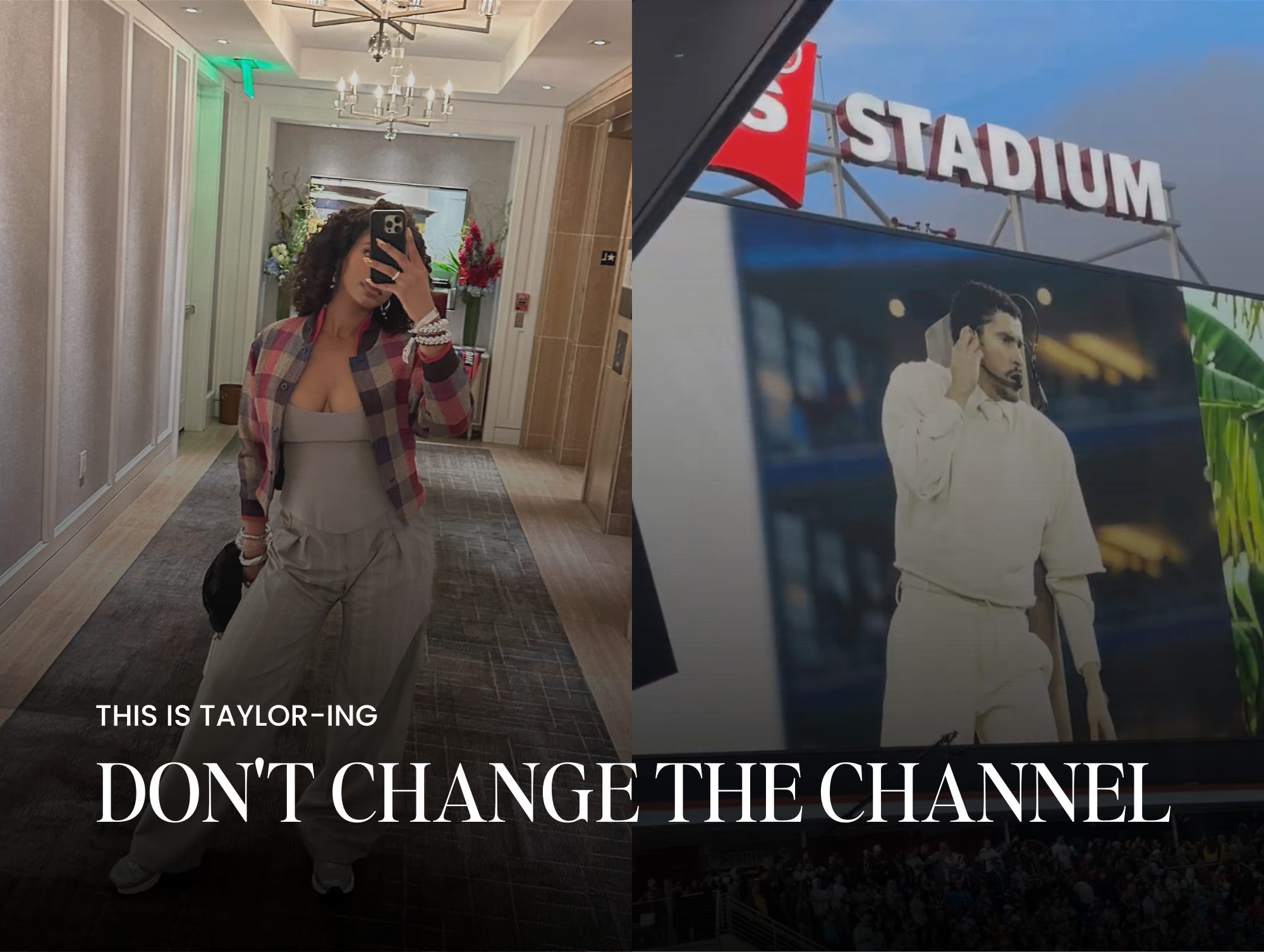

I was lucky enough to be in the house for the BENITO BOWL! I only know a few Bad Bunny songs, but the handful that I do know….I love. The story of Bad Bunny is an incredible testament to what is possible if you believe that nothing is impossible. And I’m forever a fan of that belief.
I’ve seen a few posts floating around lately about the history of the Super Bowl halftime show, and being there this weekend…and because it’s Black History Month… made me want to expand on it a bit.
The first halftime show I remember vividly was 2004. Justin Timberlake and Janet Jackson, which honestly deserves its own post on another day. But I was born in 1992. I don’t remember a world where halftime wasn’t the greatest show on earth.
There’s a reason the Super Bowl halftime show is what it is today. And it has very little to do with football.
Before it became the most coveted stage in entertainment, halftime was dead air, functionally at least. You went to the bathroom. You refilled your plate. Networks filled the space with marching bands, a commissioner speech, maybe a children’s routine. It was programming for the people in the stadium, not the people watching at home. It wasn’t designed to hold attention. And it didn’t.
What changed wasn’t the NFL’s imagination. It was the audience’s power. Specifically the black audience’s power.
In the early 1990s, In Living Color was one of the most influential shows on television. The sketch show created by Keenen Ivory Wayans and starring Damon and Marlon Wayans, it centered a Black, culture forward audience that existing comedy shows didn’t always prioritize. It also introduced the world to talents before they were household names. People like Jamie Foxx, Jim Carrey, and Jennifer Lopez, who was one of the Fly Girls.
Music wasn’t a sidebar on In Living Color, it was a pillar. Hip-hop and rap acts were given a national stage at a time when they were still routinely marginalized or treated as niche. And the audience responded. Nearly 13 million people tuned in every Sunday night. It was a cultural force.
Then came the moment that forced the NFL to pay attention.
In 1992, the Super Bowl halftime theme was Winter Magic. A nod to the upcoming Winter Olympics. The show featured figure skating legends Dorothy Hamill and Brian Boitano, plus a musical performance by Gloria Estefan.
At the same time (and the following is very abbreviated explanation), FOX locked in a quiet network war with CBS, the NFL’s broadcast partner…made a calculated move. They aired a special episode of In Living Color DURING halftime. Specifically designed to capture that audience. To say it did is an understatement.
Color Me Badd performed “I Wanna Sex You Up.” The cast ran football themed sketches, including the popular (ripe with rightful backlash and controversy) Men on Football sketch. Jim Carrey opened the show by pointing out the countdown clock to kickoff, so viewers would know exactly when to switch back.
TWENTY TWO MILLION PEOPLE CHANGED THE CHANNEL. CBS’s halftime ratings cratered. The second half of the game suffered. And the NFL publicly acknowledged it would never let that happen again.
What followed wasn’t accidental. It was reactive.
The league realized something essential: attention is cultural currency, and Black creators were holding it. Structurally. The audience wasn’t just watching In Living Color because it was funny. They were watching because it reflected a cultural pulse the NFL hadn’t harnessed.
So the league did what institutions often do when they’re forced to reckon with influence they don’t control: they absorbed it. The next year, the Super Bowl halftime show featured Michael Jackson.
That performance redefined the slot. Halftime became appointment television. A global stage. A spectacle. Not because the NFL suddenly understood music, but because the culture had already proven what people would stop everything to watch. That’s the part that often gets lost in the discourse.
Every year we debate whether the halftime performer was “big enough,” “relevant enough,” or “worthy enough” of the stage….without acknowledging that the stage itself exists because of incidental cultural pressure applied from the outside. It wasn’t a gift. It was a correction.
The halftime show is often framed as the NFL lending credibility to artists. Historically, it’s been the opposite. Artists lent urgency, relevance, and meaning to the moment Artists forced the moment to evolve.
Halftime exists because culture demanded it. Its job isn’t to crown relevance. It’s to acknowledge it. Reflecting where culture already is, not deciding where it’s allowed to go.
Issa Rae’s HBO documentary “Seen & Heard” dives into this moment and many other monuments of black television. Highly recommend it.
And if you’ve never seen the In Living Color halftime episode. Here it is below:



I admire women that can do a football game in the cute casual sporty outfits that require heels, but it’s just not for me. It’s way too long of a game, entirely too big of a stadium, and just a bit too much walking. So here’s how my stylist Bec got me together for the Super Bowl! We did a fun monochromatic look. Big slouchy gray slack pants and a structured sleeveless top. It gets really chilly at night in San Francisco so we paired it with a Vintage Dior jacket for a sporty vibe. Lots of statement chunky Alexis Bittar jewelry for some girly flair and Celine sunglasses for a moment. Definitely my fave Super Bowl fit.

I’ve realized I don’t always say my first thought. You should never say EVERYTHING. But the first thought feels too blunt. The second feels incomplete. Then the third doesn’t sound smart enough.
So I end up offering the fourth or fifth version of how I feel edited, softened, approved by an internal committee that exists solely to make me palatable. By the time it leaves my mouth, it’s a version of the truth that’s been diluted enough to survive the conversation.
Thinking about what we’re going to say can be a form of dishonesty. We’re not lying about facts or covering wrongdoing. We’re just slowly erasing ourselves. Sanding down the sharp edges.
I admire people who say exactly what comes to mind. There’s a true self trust there. It’s not that they’re careless; it’s that they believe their thoughts are allowed to exist in the room. That kind of honesty is a practice.
Elders are often blunt in a way that feels almost refreshing. Not because they’ve lost social awareness, but because they’ve lost patience for self-erasure. The older they get, the less they edit. The less they perform. They decide the cost of constant filtering is higher than the cost of being misunderstood.
We tell people all the time to “Just be yourself,” while rarely doing it ourselves.
Thinking before we speak matters of course. But to what end? thinking shouldn’t mean censoring. It shouldn’t turn every interaction into a pressure-filled exercise in saying the right thing instead of your thing.
I noticed this most clearly when I started therapy years ago. I was sitting in a space designed for honesty and still editing myself. Applying the same filters. Polishing my feelings before offering them up. There was no growth in that. And if I was doing it in the safest room imaginable, I was absolutely doing it everywhere else without realizing it.
How many cages we build in our own minds.
One of my goals this year is to censor myself less. To think less and feel more. To say the thing closer to when it arrives. To trust my mind as it is, not as I think it should sound. Every time I do this, I feel freer. Lighter. More alive. The freedom isn’t found in perfect phrasing, it’s found in the permission you give yourself. It’s one of the reasons I write these every month.
What’s the worst thing that could happen if you say the first thing on your mind? You might be misunderstood. You might have to clarify. You might learn something about yourself you didn’t expect.
But it’s still easier than living as a translation of who you are.
I’ve also noticed how much this filtering harms creativity. When our thoughts have to pass a series of internal checkpoints before they’re allowed to exist, our imagination shrinks.
My husband and I have done improv classes before and I LOVE it. A weight feels lifted off my shoulders when I leave. This year I’m going to do them on my own regularly. In improv they teach you the “yes, and” philosophy. But it isn’t just about comedy. It’s about momentum. It keeps you moving forward instead of freezing in self-correction. It invites exploration, missteps, surprise.
Our minds already run an exhausting system of checks and balances. Some filtering is necessary…context matters. But most of the time, it’s a hindrance. It keeps us from asking for what we want. From saying what we mean. From being who we are.
The truest version of you is often who shows up first. The work isn’t to be more articulate. The work is to be more honest.
How much of yourself are you changing in order to be yourself?

Once again, Think•ing is my inner monologue reflected back to me, in the very best ways. The notion that maybe we’re not as ready to be seen as we may think when we filter our thoughts (which we serial overthinkers tend to do by default) and that doesn’t necessarily make us inauthentic, we’re just constantly finding our voices over the debris. Thank you so much Taylor. Your bi monthly correspondence makes me feel so seen. ❤️
This is fascinating, Ms. Rooks. Thanks for taking us back to the 1992 Super Bowl halftime and framing it as the powerful, culture-shifting, historical moment it was. I was in middle school in the 90s and I loved "In Living Color," so their halftime show was not to be missed. Incidentally, I also associate 1992 with team USA's Dream Team, which I was super excited about. ;) I was quite the NBA fan girl, I guess. 🏀